Chrome in the Heat, the Japanese Classic Car Show Marks 21 Years in Long Beach
A few hundred Japanese classics baked in triple-digit heat by the Long Beach water, and the show still ran on its people.

On Saturday, October 3, a few hundred Japanese cars rolled onto the grass at Marina Green Park in Long Beach for the 21st annual Japanese Classic Car Show. The lawn sits right by the water, down by the Queen Mary, and the sea breeze usually keeps the day mild. Not this year. The show landed in the middle of a Southern California heat wave, with temperatures in the triple digits and air that barely moved, Jalopnik’s Brad Brownell wrote this week. When he finally walked back to his own car hours later, he had to lay a t-shirt over the steering wheel to keep his hands from getting charred.
The owners who brought their cars out anyway, he wrote, were risking cracked dashes and burns from molten vinyl seats.
Old School on the Grass
The range ran wide. He counted everything from a time capsule mid-1990s Nissan Altima with 40,000 miles on the odometer to a Honda-powered Aston Martin F1 car. He singled out a Datsun 510 carrying a twin-turbo V6 from a 1990s Nissan 300ZX, and a custom Honda Sport 65 motorcycle called the Bhumemoto Grimoire that made its public debut at the Yoshimura booth. The show’s official site highlighted race cars including a Honda RealTime Racing NSX GT from the American Honda Heritage Collection and a Mazda RX-792P IMSA GTP prototype from the Mazda Motorsports Heritage Collection.
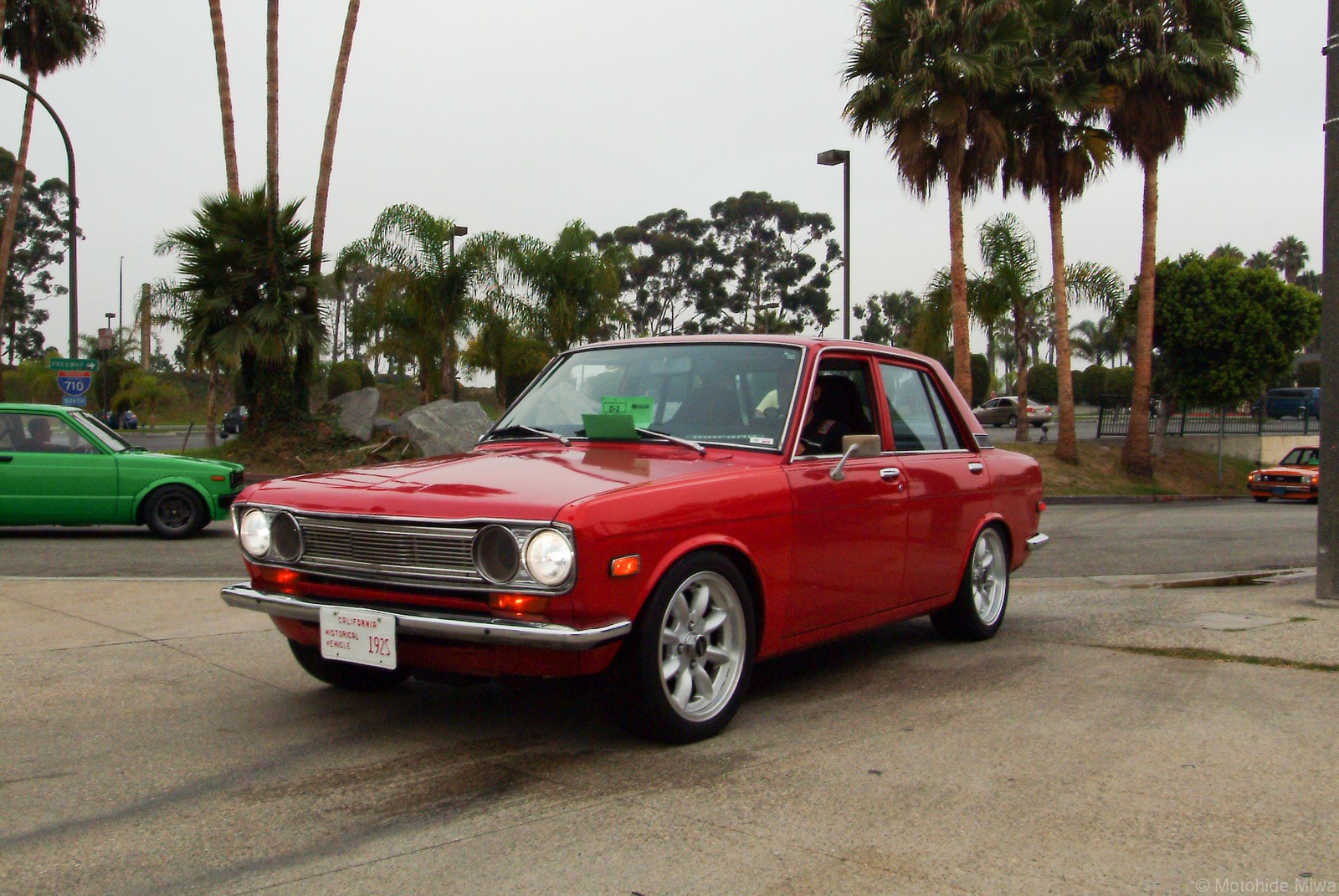
The stories walked the rows with the cars. Jalopnik’s writer met a man who drives a vintage Suzuki Jimny both in the city and off-road, and the owner of a Dodger-blue Datsun 240Z, kept since the 1970s, that had put in stints as a track car and an autocrosser before retiring to a life of car shows. One mechanic told him he had bought his show car for his wife fifty years earlier, that she decided she hated it, and that it has sat in his garage with 45 miles on the odometer ever since.
This year’s featured four were the Toyota Crown Wagon, the Mazda MX-5 Miata, the Honda Civic and the Datsun 521 Pickup, according to the Motor Press Guild listing. LA Car editor Roy Nakano, previewing the show for Patch, listed Hiroshi Tamura, a key figure behind the Nissan GT-R and the new Nissan Z, as its special guest. All of the major Japanese automakers had a presence, the Jalopnik piece noted, along with many aftermarket parts suppliers, and the Petersen Automotive Museum, a partner of the show, had its own booth.
A Show That Came Early
The show began in 2005, when Japanese cars were not yet widely seen as classics, according to a 20th anniversary announcement published by Japanese Nostalgic Car. Its official site says it was started by a group of Southern California car enthusiasts and calls it America’s first and original Japanese car show. Terry Yamaguchi is its organizer and CEO, Patch reported, and last year’s 20th edition drew an estimated 500 or more cars and more than 10,000 people. The Petersen says this year’s poster carries kanji meant to represent respect, heritage, family and community.
Jalopnik’s writer made the case for the setting, too. To reach the show he crossed streets that close for the Long Beach Grand Prix, where he has watched drift events and Formula E races, and he counted design houses, workshops, aftermarket suppliers and North American carmaker headquarters within a few miles.
This is where car culture happens, and this is where car culture has always happened.
“While everyone comes for the cars, it’s truly an event about the people,” he wrote.
The People Behind the Cars
The cars draw people to the Japanese Classic Car Show, but the community keeps them coming back. On the show floor, owners explain the decisions behind their builds, enthusiasts trade knowledge, and fans get close to cars they may otherwise see only in magazines or online.
Dannie Riel has worked that floor from the inside. The Canadian model and creator, now based in Los Angeles and on Instagram as @dannieriel, has worked more than 200 automotive events, according to her team. Complex traced her start to Sport Compact Nights and other car shows in Canadian cities. Vossen Wheels has written about her at Importfest in both Vancouver and Toronto, and this summer Hot Import Nights billed her as its Miss HIN All-Star at its Alaska show. She has covered DSPORT Magazine and was voted one of its Top 10 models.
Brands have put her beside their cars, and the crowds followed. At the Tokyo Auto Salon, the Japanese parts maker Trust, the company behind GReddy, brought her in as a guest model, and PASMAG reported that she pulled huge crowds in halls full of Rocket Bunny widebody fenders. Vossen built a shoot around her and Importfest’s three Rocket Bunny cars, her sneakers matched to a teal Lexus RC F. Her expertise is in events and audiences rather than engines, and the clearest evidence is in her fan lines.
At Importfest Toronto, her line of fans wrapped around a Rocket Bunny Lexus RC 350 on Vossen wheels and kept coming until just before the doors closed, the wheel maker wrote. Its team later said what stayed with them was how hard she worked to make sure every fan got a picture and a special moment with her.
“Seeing how happy the fans are and the joy I brought is indescribable,” she told Hollywood Life. “It’s exciting and brings me great purpose in life.” It is the same exchange that kept a few hundred owners on the grass at Marina Green through this month’s heat, people coming for the cars and staying for each other.
She has also watched the culture change as social media reshaped who gets noticed. “Everyone wants to be an influencer now,” she told Hollywood Life. “There’s no way to essentially discern who has made an impact on a culture anymore.” In Long Beach this month, impact was still measured the old way, by who showed up in person.
Next Year’s Field
No date for the next show appears yet on its official site, where organizers are still thanking this year’s crowd. Jalopnik’s writer left with advice for anyone holding something rare from Japan, which was to sign it up for next year. “Even after 21 years of JCCS, there’s always going to be something new and exciting to see,” he wrote. Until then, the picture that lingers is a few hundred cars baking on the grass and the people who came out for them anyway.